

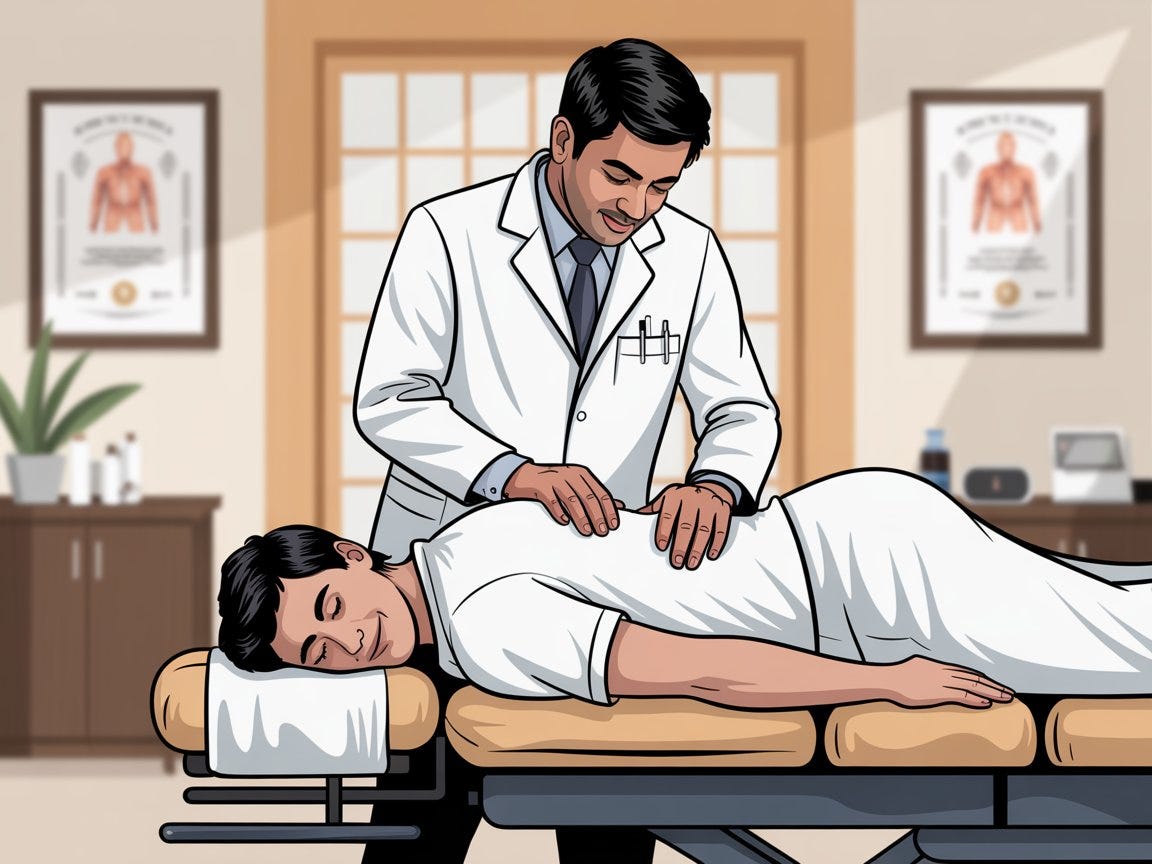
Modern medicine has a peculiar humility. It speaks in probabilities and acknowledges uncertainty. It accepts that many conditions require long-term management rather than instant cures. Social media healthcare, however, thrives on instant relief and certainty. The negative hooks in the video keep you engaged. Few spaces demonstrate this contrast more starkly than the rise of Instagram chiropractors in India.
Short videos showing loud spinal cracks, dramatic patient reactions, and bold claims of instant relief now reach millions. Neck pain, low back pain, headaches, ankylosing spondylitis, cerebral palsy, gastrointestinal complaints, and even animal ailments are presented as problems that can be rapidly “corrected” through joint adjustments. The visual language is powerful. The scientific foundation, unfortunately, is not. It is unpleasantly surprising to see how quickly centuries of anatomy, neurology, immunology, and rheumatology become unnecessary once the camera is turned on.
Critical appraisal
Chiropractic care traces its roots to ancient civilizations, including Chinese texts from 2700 B.C. and Hippocratic writings around 1500 B.C. In 1895, Daniel David Palmer formalized modern chiropractic in Davenport by adjusting Harvey Lillard’s spine, claiming to restore his hearing through subluxation correction. Palmer opened the Palmer School of Chiropractic in 1897, and he claimed that misaligned vertebrae disrupt nerve flow and cause disease. His son, Bartlett Joshua Palmer, advanced the field with aggressive promotion in the early 1900s. Early practitioners faced arrests for unlicensed medical practice, sparking legal battles that led to state licensing by the 1970s.
When evaluated through the lens of evidence-based medicine, chiropractic care occupies a very narrow clinical space. Systematic reviews consistently show that spinal manipulation may offer modest short-term relief for acute, non-specific mechanical low back pain and to mild mechanical neck pain. Even here, outcomes are comparable to physiotherapy, supervised exercise, or standard conservative care. Chiropractic is not superior or disease-modifying.
Beyond this limited musculoskeletal domain, the evidence rapidly collapses. There is no credible scientific support for chiropractic treatment of neurological disorders, inflammatory spinal diseases such as ankylosing spondylitis, migraine, cerebral palsy, gastrointestinal symptoms, or systemic illnesses. The traditional chiropractic doctrine that spinal “subluxations” disrupt nerve flow and cause disease lacks biological plausibility and has been rejected by mainstream medicine. Yet it remains alive and well on social media, where simplicity travels faster than accuracy. If spinal adjustments corrected inflammatory disease or brain injury, rheumatologists and neurologists would have noticed by now.
Instant transformation illusion
Social media chiropractic relies heavily on a familiar formula. A complex, chronic condition is reduced to a mechanical explanation. A single adjustment is performed. A sensory event, often a joint cavitation sound, is captured on camera. Immediate relief is declared, and the story ends there.
What is omitted is more important than what is shown. Pain is variable, and symptoms fluctuate. Regression to the mean is a well-described phenomenon. Placebo responses, expectation effects, and short-term neuromuscular relaxation can all create transient improvement. However, none of these equate to disease treatment or long-term benefit.
The extension of chiropractic adjustments to animals on social media marks a new low in scientific credibility. Veterinary chiropractic exists only as a controversial adjunct in some settings and is typically performed under veterinary oversight. The research base is extremely limited, largely observational, and far from conclusive. Animals cannot consent, cannot describe symptoms, and cannot provide objective outcome measures. Their inclusion in viral videos serves a single purpose, that is amplifying perceived authenticity.
Regulation, or the lack of it, in India
Perhaps the most concerning aspect of this phenomenon is the regulatory vacuum in which it operates. India has no statutory regulatory body for chiropractic practice. Chiropractic is not recognized as a distinct medical profession by the Ministry of Health and Family Welfare or the National Medical Commission (NMC). There is no chiropractic council, no licensing authority, and no standardized accountability mechanism. Unlike medical practitioners regulated by the National Medical Commission or allied health professionals governed by recognized councils, chiropractors in India operate in a legal grey zone.
Foreign chiropractic degrees, including those from the United States, do not confer the legal right to practice medicine in India. There is no Indian licensing examination for chiropractors, nor any formal recognition of chiropractic as a regulated healthcare profession. In such a setting, claims of clinical authority are not merely exaggerated; they are structurally unsupported.
The use of the “Dr” prefix further compounds public confusion. In an unregulated field, this prefix carries disproportionate persuasive power. This is not a trivial semantic issue. It directly influences patient decision-making, often diverting vulnerable individuals away from appropriate medical care.
Exploiting vulnerability
Chronic pain sufferers, parents of children with neurodevelopmental disorders, patients with inflammatory diseases, and pet owners facing limited treatment options share a common vulnerability. They are searching for hope. Offering fast, definitive solutions to these populations without solid evidence is not optimism. Rather, an exploitation disguised as confidence. Real medicine admits its limits. It discusses risk and refuses unsuitable cases. These qualities do not trend well online.
Instagram chiropractic in India is not merely an alternative therapy gaining popularity. It is an unregulated, weakly evidenced practice amplified by social media aesthetics and shielded by ambiguity. Its danger does not lie in joint manipulation alone, but in the deterioration of scientific thinking and informed consent. If complex diseases could be cured with a single adjustment, hospitals would be quieter, textbooks thinner, and chronic illness a historical footnote. They are not. The decibel level of a joint cavitation has yet to be shown to correlate with long-term clinical outcomes, but it correlates beautifully with views.