

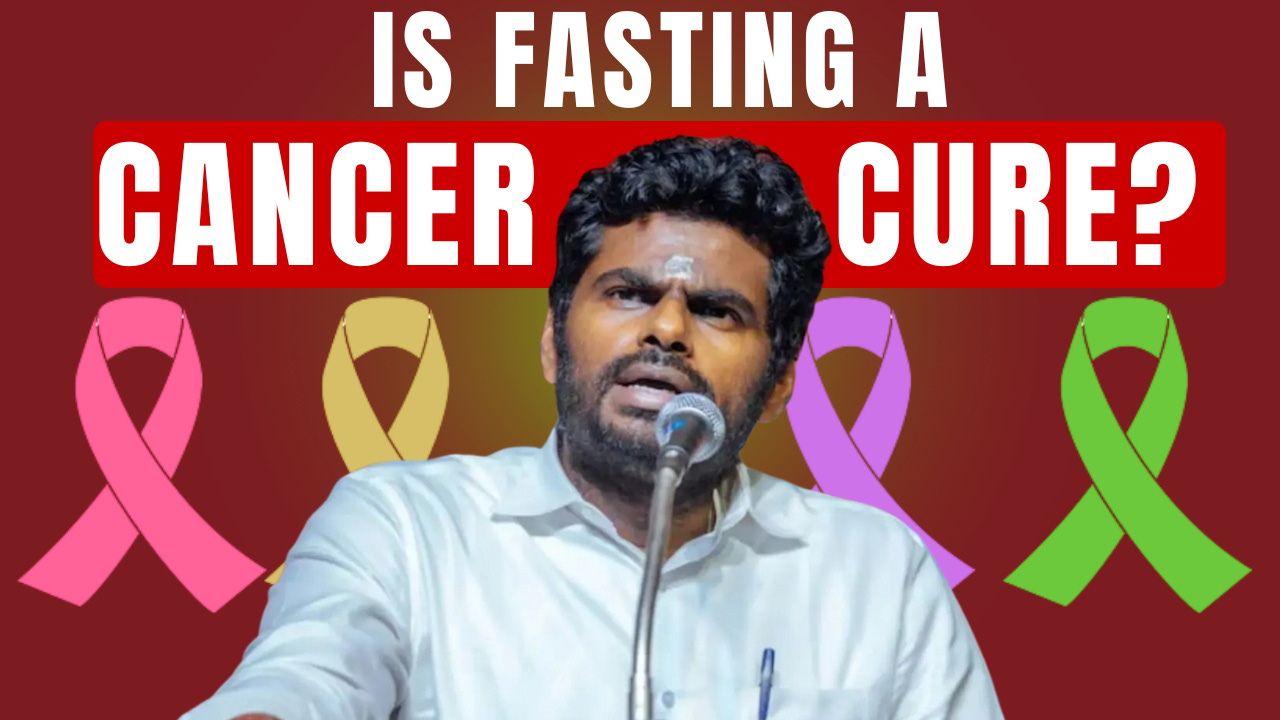
There is a simple rule that rarely fails to hold true. When someone offers an easy solution to a complex problem, think twice. If curing cancer were as simple as fasting for a few days, oncology departments around the world would be empty by now. The oncology textbooks would have been thinner than restaurant menus. TATA Memorial Hospital (one of the best in India for oncology) wouldn’t have taken 24 doctors every year for oncology training. The so-called “money-looting” private cancer centres won’t invest in costly machines like PET-CT, LINAC, and Gamma Knife. Loki rightly said in one of the Thor movies, “If it were easy, everyone would do it”.
Recently, K. Annamalai suggested that prolonged fasting could starve cancer cells and potentially lead to a cure for cancer. This statement matters not just because it is scientifically incorrect, but because of who said it.
Annamalai is a former IPS officer and the most visible face of the BJP in Tamil Nadu. Even though some people oppose him because of his political ideology, his academic credentials are excellent. For many people, that background signals authority and credibility. When such a figure speaks about health, people are more likely to believe him than their doctor. That is where the real danger lies.
Cancer is a complex disease
At its core, cancer is a genetic disease. Every cancer begins with genetic alterations within a cell. The reason for the genetic alteration can vary between patients and different cancers. The cause will be an inherited mutation, exposure to toxins, infections, radiation exposure, etc. Even advanced age can predispose to cancer due to wear and tear in the DNA repair mechanisms.
Lifestyle factors can influence cancer risk, but they do not override biology. Cancer does not develop because someone failed to fast. And it does not disappear because someone starts fasting. Cancer risk is shaped by a complex interaction of genetic susceptibility, age, hormones, infections, environmental toxins, radiation exposure, and lifestyle factors such as smoking, alcohol use, diet, and physical activity. This is why single-cause explanations are so appealing and so misleading. Complex diseases do not have shortcut solutions.
People want simple explanations and solutions for complex problems. Doctors can’t provide that always, and that’s where pseudoscience peddlers enter.
Obesity and cancer risk
Obesity is clearly associated with increased risk of at least 13 types of cancer, including postmenopausal breast cancer, colorectal cancer, endometrial cancer, liver cancer, and esophageal adenocarcinoma. The mechanisms are well studied. Chronic inflammation, insulin resistance, altered sex hormone levels, and adipokine imbalance, etc. contribute to cancer risk. Addressing obesity is good medicine.
But here is where we have to draw the line. Reducing risk is not the same as treating cancer. Fasting can improve metabolic health and aid fat loss when done in a structured, supervised manner. For individuals with obesity, it can be beneficial for overall health. Fat loss has innumerable benefits, but fasting is not a standalone cancer treatment.
Cancer cells are metabolically adaptable. When glucose levels fall, many tumors switch to alternative energy sources such as fatty acids, ketone bodies, or amino acids. They do not die because food intake is reduced. In real patients, prolonged or unsupervised fasting often harms normal tissues before it harms cancer cells. There is no clinical evidence that fasting alone can cure cancer. A cancer patient, in fact, requires an adequate amount of nutritious food with the recommended amount of protein.
India has seen this before. Navjot Singh Sidhu has previously made claims linking diet and lifestyle practices to curing cancer, in the context of his wife’s battle against cancer. But, he conveniently forgot the evidence-based treatment she received. Each time, doctors are forced to clean up the damage caused by oversimplified narratives. The pattern is familiar. A complex disease, a confident public figure, and an easy solution.
Why this matters so much
When influential figures promote unproven ideas, some patients may delay surgery, chemotherapy, or radiotherapy. Some may even totally abandon evidence-based treatment. More importantly, this will create distrust of oncologists among the people. Cancer patients are already vulnerable to malnutrition, muscle loss, immune suppression, and cancer cachexia. Unsupervised fasting can worsen outcomes and reduce tolerance to life-saving therapies.
Research continues on short, supervised fasting or fasting-mimicking diets as supportive strategies during cancer treatment. These approaches are experimental, adjunctive, and used only alongside standard therapy under medical supervision. They are neither cures nor replacements for evidence-based treatment.
Always be cautious when a complex disease is offered a simple fix. If it were that easy, medicine would have adopted it long ago. Supervised fasting can improve metabolic health and help with fat loss. Fasting may reduce long-term cancer risk indirectly by addressing obesity. But fasting is not a cancer treatment. Public influence carries responsibility. Authority in administration or politics does not translate into expertise in medicine. Cancer care must remain grounded in genetics, biology, and evidence, not in appealing shortcuts. Patients deserve nothing less.
If cancer could be cured by not eating, humanity would have accidentally solved oncology during its first famine.
Thank you so much for putting the right perspective here.